


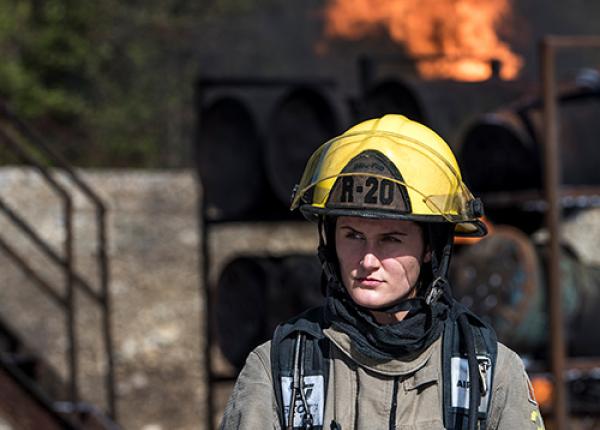
Is this program right for you?
If you’re a team player who’s physically fit, community-minded, and eager to make a difference, this program could be the right path for you. Firefighters protect lives, homes, and communities. It’s work that demands skill, courage, and dedication.
What you’ll gain?
- Real-world experience at Western Canada’s largest fire training campus.
- You’ll learn directly from experienced fire training officers who will support and mentor you throughout your journey.
- Training from an IFSAC and ProBoard® accredited institution, ensuring your education meets international standards.
From live-fire scenarios to practical skills you’ll use on the job, this program prepares you to meet the national and international standards required to work as a professional firefighter.
This program is for people who:
- Want the essential training and certification to become a firefighter
- Are committed to serving their community and public safety
- Thrive in team environments (for example, team sports, collaborative work settings, volunteer groups, or any situation where coordination and shared goals are key)
- Are motivated to keep learning and developing new skills
- Value their physical and mental well-being
- Have mechanical skills or aptitude
Graduates often include people with backgrounds in:
- Skilled trades
- First responder or first aid training
- Team sports or athletics
- Military service
- Volunteer work in their community
- Post-secondary education
- Entrepreneurship or small business
- A passion for fire service and public safety
Program strengths
- Learn from experienced fire training officers who mentor you throughout the program
- Train at our 25-acre Maple Ridge Fire Campus, with hundreds of hours of live-fire experience
- Access 30+ training props, including:
- A three-storey burn building
- Steel ship training prop
- Rope rescue tower
- Western Canada’s only 11-car train derailment prop
- Connect with fire department representatives through fire hall visits and ride-along experiences
- Comprehensive evaluations to prepare you for NFPA Firefighter I and II certification
- Credentials accredited by IFSAC and ProBoard®
- Volunteer opportunities during and after the program to expand your experience and connections
You’ll build the skills and knowledge to meet the National Fire Protection Association (NFPA) Standard for Firefighter Professional Qualifications. If you also complete JIBC’s Hazardous Materials courses, you’ll earn certification for Hazardous Materials/Weapons of Mass Destruction (WMD) Standard for Responders
Key subjects include:
- Safety and communication
- Personal protective equipment (PPE) and SCBA use
- Fire ground accountability
- Water supplies and hose handling
- Ground ladders and hoisting equipment
- Forcible entry and tools
- Search, rescue, and firefighter survival
- Fire extinguishers and live-fire control (vehicle, Class A, flammable gas/liquid)
- Interior and exterior fire attack techniques
- Understanding fire behaviour and predicating fire growth
- Team-based decision-making in live-fire scenarios
What You Need to Graduate
The program is divided into three parts: online firefighting knowledge-based courses, on-campus firefighting applied learning courses, and a liberal studies component.
Complete the online and on-campus firefighting courses to receive "NFPA 1010 Certificate" with IFSAC and ProBoard® seals.
Complete the liberal studies component of the program to receive the 30-credit, academically recognized Firefighting Technologies Certificate.
If you have completed relevant liberal studies courses at other post-secondary institutions, you can apply for Transfer Credit towards the certificate.
Program Format
This program starts you off with online courses for the first 12 weeks. After that, you will begin in-person training for 7 weeks.
Online knowledge/theory-based courses allow the flexibility to learn from home. Full-time in-person training is held at our world-class facility in Maple Ridge, Monday to Friday. *
*An occasional Saturday may be scheduled to compensate for Campus Closures due to statutory holidays.
Upcoming Intakes
| Class | Online Start | On Campus Start | Application Deadline |
|---|---|---|---|
| R60 | October 5, 2026 | January 11, 2027 | July 8, 2026 |
| R61 | November 30, 2026 | March 1, 2027 | September 2, 2026 |
| R62 | January 18, 2027 | April 26, 2027 | October 21, 2026 |
Textbooks & Supplies
We will supply you with course manuals when you attend class. If additional books or other materials are required, we will let you know when you are accepted into the program.
Uniform
You must purchase a uniform for the practical component of the program. All uniforms MUST be obtained from the JIBC Store.
Do not purchase these items unless you have received an acceptance letter into the program and a JIBC Uniform Order Form has been sent to you.
Mandatory Items to Order for First Day of Class
- 1 Navy station pants (pants must be hemmed)
- 1 Navy uniform short-sleeve shirt
- 1 Clip-on navy tie
- 1 pair – Fire & Safety crests. (Have crests sewn on navy uniform short sleeve shirt. Ask staff at JIBC Store where to place crests on sleeves).
- 2 Fire & Safety navy short sleeve gym T-shirt (3 recommended)
- 1 Pair of black composite-toes safety boots*
- 1 Black leather belt*
* Belt & boots are mandatory items but can be purchased through the JIBC Store or a store of your choice as long as they meet the CSA approval. All boots must be steel-toed or composite-toed and able to hold a shine and be CSA approved.
Note
All prices are subject to applicable taxes and may change.
NFPA 1010 Firefighter I and II Professional Certification (21.5 credits)
Tuition (April 1, 2026 – March 31, 2027)
Domestic Tuition: approximately $10,568. Program deposit: $500
International Tuition: approximately $31,700. Program deposit: $5,000
Program deposit is due eight weeks prior to the start of the program and will be credited towards tuition. This deposit is non-refundable and non-transferable.
Additional Fees (as of April 1, 2024, subject to change)
- Domestic Application Fee: $75 (non-refundable, non-transferable)
- International Application Fee: $150 (non-refundable, non-transferable)
- Student Union Fee: $70 (approximately)
- Student Union Health & Dental: $295 (approximately)
- Textbook: $225 (approximately)
- Uniform: current pricing is provided by the JIBC Bookstore
- Equipment Rental: $965 (approximately)
- Domestic EMRG-1200 Incident Command System Level 100: $49.38*
- International EMRG-1200 Incident Command System Level 100: $135.38*
- Domestic HZMT-1100 Hazardous Materials - Awareness: $69.56*
- International HZMT-1100 Hazardous Materials - Awareness: $195.92*
- Domestic HZMT-1110 Hazardous Materials - Operations: $1,330.96*
- International HZMT-1110 Hazardous Materials - Operations: $3,941.80*
Fire Fighting Technologies Certificate (30.5 credits)
Tuition (April 1, 2026-March 31, 2027)
Domestic/International Tuition/Deposit: identical to NFPA 1010 Firefighter I and II Professional Certification
A program deposit is due eight weeks before the start of the program and will be credited toward tuition. This deposit is non-refundable and non-transferable.
Additional Fees (as of April 1, 2024, subject to change)
- Identical to NFPA 1010 Firefighter I and II Professional Certification.
* You must register for these additional courses separately from the FFTC program. You can pay for them at the time of registration. If you completed these courses at other post-secondary institutions, you can apply for a Transfer Credit.
STEP ONE - Submit Your Application Form and Prerequisites Assessment
Complete your application form and pay the application fee via EducationPlannerBC. You must submit all prerequisite documentation by the application deadline to admissions@jibc.ca.
The application process requires the submission of all paperwork confirming the mandatory prerequisites are met. You are responsible for ensuring the package is complete with all documentation. You must submit the documents by the application deadline.
Selection Process Results
We will email you to let you know if your application is incomplete. At that point, you can contact us for further information.
We will compile the results from each component to produce a candidate score. We will use this score to rank a list of candidates and fill program seats by working from the top of the rank order list down.
If you are a successful candidate, we will contact you to offer you a seat in an available class. If you are an unsuccessful candidate, you will receive an email inviting you to contact us for further feedback. We will also provide developmental suggestions if you decide to apply again.
STEP TWO - Receive Acceptance and Make Payment
If you are a successful candidate, we will contact you to offer a seat in an available class.
A $500 non-refundable Commitment Fee is required to secure your seat and is applied towards your tuition.
Admission Requirements
Mandatory Requirements
- Be a minimum of 18 years of age by the start date of the program
- Official Transcript showing completion of Grade 12 English. You MUST also have Grade 12 English with a minimum grade of “C” (or at least 60%)
- Complete the JIBC Online Application Form via EducationPlannerBC. (Go to the site, create an account, and
apply to JIBC). - Basic First Aid (minimum 8-hour course) with CPR level C.
- Proof of Physical Ability provided by one of the following:
- West Coast Kinesiology and Physiotherapy Physical Activity, Fitness and Lifestyle Appraisal
- Fitness Assessment (Test) from a University (ex. UBC, UVic, UofT, etc..) that measures strength, speed, power, flexibility, cardiovascular endurance, aerobic capacity, body composition, and task-specific hand-eye coordination.
- Proof of Medical Clearance which includes BOTH:
- A Physical Activity Readiness Questionnaire (PAR-Q+).
- A Doctor’s note indicating the student is fit to undertake firefighter training.
Beneficial Prerequisites
- Community or volunteer experience
- Fluency in an additional language other than English
- Above average physical fitness
- Experience being a part of a team
- Mechanical aptitude
- Positive attitude and good work ethic
- Life experience and a mature attitude
- Ability to take direction
- Demonstrated responsible behaviour
Special Note
An Interim Transcript is acceptable upon application, but the OFFICIAL Transcript must be provided prior to the program start date (Post-Secondary Transcript is also acceptable). This is a requirement unless you are submitting a transcript for a post-secondary DEGREE. If you have a post-secondary DIPLOMA, you still need to submit your Grade 12 Transcript.
Financial Aid & Awards
This program is eligible for student loans, external awards, JIBC awards, bursaries and scholarships.
International Applicants
International applicants are encouraged to visit the International Studies page or contact JIBC's Office of International Affairs.
Q: How do I know if I'm the right kind of person to do this job?
A: We recommend attending an upcoming hands-on firefighting information session to learn if you're the right kind of person to do this job.
Q: Are there financial aid options available for students in this program?
A: Yes. Students in the full-time and part-time programs are eligible for financial assistance from StudentAidBC. Students accepted into the program are also encouraged to apply for, external and internal student awards, scholarships, and bursaries.
Q: Are international students eligible to take this program?
A: Yes. International students should contact the JIBC Office of International Affairs to discuss their options and requirements for applying to the program.
Q: I've taken some liberal studies courses at another post-secondary institution. Can I gain transfer credit?
A: Yes. JIBC is a full participant in the credit transfer system of the BC Council on Admissions and Transfers (BCCAT). We work with that system to facilitate transfer agreements that benefit BC students. Further information on how your credits might transfer is available from the BC Transfer Guide.
Courses in This Program
Core Courses (For NFPA 1010 Certification)
Liberal Studies Electives* (Choose one from each category)
Communications, Oral and Written
| ENGL-1100 Academic Writing | ENGL-1110 Critical Reading and Writing Skills |
| BUSN-1100 Business Communications |
Critical Thinking
| ETHS-1100 Applied Ethics | BUSN-1101 Introduction to Human Resource Management |
Problem Solving
| ETHS-1100 Applied Ethics | CRES-1851 Introduction to Conflict Analysis and Resolution |
| RESM-2100 Research Methods |
Note
* Elective credits are required for the Firefighting Technologies Certificate (30 credits) but not the NFPA 1010 Firefighter II Professional Certification (21 credits).
Learners should choose electives based on the three competencies listed above. The associated JIBC Liberal Studies courses are listed below each competency, but learners may also apply for transfer credit if they have met the competency through another post-secondary institution.


